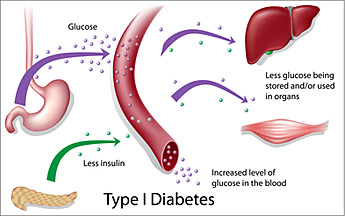
A Spectrum of situations are possible in type I, from Insulin deficient ketoacidotic state with greatly elevated glucose, Free Fatty acids, ketones and lipolytic enzymes such as glucogon and epinephrine, to a state of continuous insulin infusion therapy with hyperinsulinemia, normal or close to normal glucose and Fatty acids level. The lipid profile was near normal in well controlled type I diabetes. In untreated type I diabetics the fractional catabolic rate for triglyceride decreased because the activity of lipoprotein lipase is dependent on insulin and leads to hypertriglyceridemia.
Some times severe enough to cause lipaemia retinalis, acute pancreatitis and eruptive xanthomas. VLDL (C) levels are greatly elevated in individuals indiabetic ketoacidotic state .LDL (C) levels are increased in poorly controlled type I subjects. LDL fractional clearance is probably decreased in poorly controlled type I individuals because insulin potentiates LDL binding to its receptors.
 The LDL particles of individuals with type I may exhibit an increase in the ratio of cholesterol to Apo - B . In addition glycation of the LDL also interferes with the clearance of it. A number of studies have shown that HDL-Cconcentrations are low in poorly controlled type I individuals and it increased with the degree of glycemic control. But some studies have shown that HDL-C concentration in type I. inciduais are higher or not lower than the control subjects. Low lipoprotein lipase activity may be an important for lowered HDL-C concentrations in type I subjects. Adequate control of plasma glucose in type I individuals leads to increase in the HDL-C levels.
Some times severe enough to cause lipaemia retinalis, acute pancreatitis and eruptive xanthomas. VLDL (C) levels are greatly elevated in individuals indiabetic ketoacidotic state .LDL (C) levels are increased in poorly controlled type I subjects. LDL fractional clearance is probably decreased in poorly controlled type I individuals because insulin potentiates LDL binding to its receptors.
The LDL particles of individuals with type I may exhibit an increase in the ratio of cholesterol to Apo - B . In addition glycation of the LDL also interferes with the clearance of it. A number of studies have shown that HDL-Cconcentrations are low in poorly controlled type I individuals and it increased with the degree of glycemic control. But some studies have shown that HDL-C concentration in type I. inciduais are higher or not lower than the control subjects. Low lipoprotein lipase activity may be an important for lowered HDL-C concentrations in type I subjects. Adequate control of plasma glucose in type I individuals leads to increase in the HDL-C levels.
Aucun commentaire:
Enregistrer un commentaire